

Exploration and Play Act 1
- Natasha

- May 3, 2020
- 6 min read
Setting the scene
The first part of the ‘Experimentation and Play’ project was Act 1: Setting the Scene. This part of the project focused on fast-paced, experimentational and expressive image making that challenged our ‘default’ position through workshops and experiences that challenge us to reflect on our go-to methods and instead take risks.
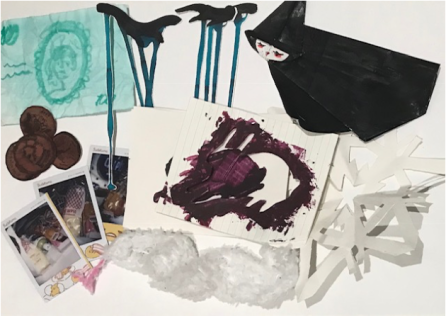
The set outcome for Act 1 was to create a box or container filled with experimentational tests and illustrations inspired by words generated from an automatic writing task and in response to set tasks.
My personal aims for this part of the project were:
Discover new techniques
Independently and effectively manage my time.
Not be scared to get messy!
Produce something that will be a great tool for me in the future.

The main starting point for this project was completed during the briefing – an automatic writing task. This task had us write out 94 words consecutively without stopping to think, just the first thing that came to your mind. This was then developed from to create the main body of work for our act 1 final outcome. We were to create experimentational responses to words that fit different criteria given to us these were:
Illustrate all the words with 5 letters
Illustrate all the words with 8 letters
Illustrate all the words that make you angry or upset
Illustrate all the words that you hate
Illustrate the words beginning with K, T or L
Illustrate words that you resonate with
Illustrate the words that make you think of the colour green, use a different shade of green for each one.
Illustrate the words that make you think of home
Illustrate the words that are objects
Illustrate the words that are surreal


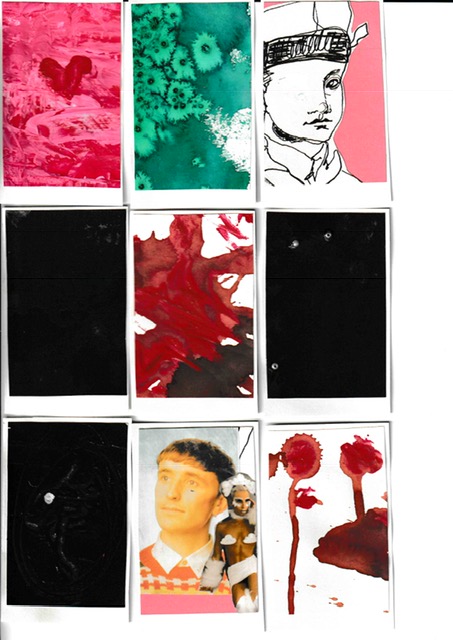

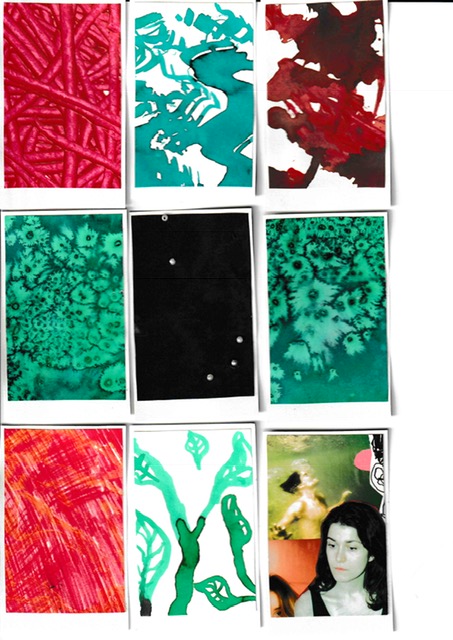


These are the experiments after being cropped so they are all a uniform and more manageable size – I did this after a self assessment that happened later on in the project.
Act 1: Primary Research – Mark Making

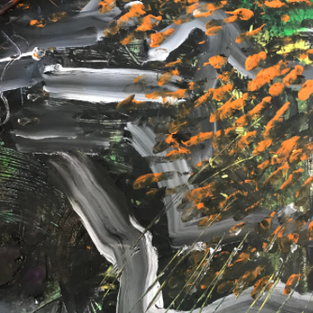


The studio session to start off Act one consisted of two parts. The first being the creation of a large group piece spread across two long tables. The creation of the piece was aided by prompts that everyone participating had to follow… for instance: ‘draw as small as you can’, ‘draw as big as you can’, ‘draw to the beat of the song’, ‘draw like a statue’ ‘scratch into the drawing’ etc. The combination of experimental mark making, unusual tools and individual interpretation by a large group created a really interesting outcome that was rich in inspiration and ideas that could be brought forward into the upcoming task.


As additional preparation for this task I created a potato stamp. I found this technique really fun and easy to use and a great way to create repeated imagery. The stamp I created was very simple but it would be interesting to see how far and with how much detail one could take this very simple technique.

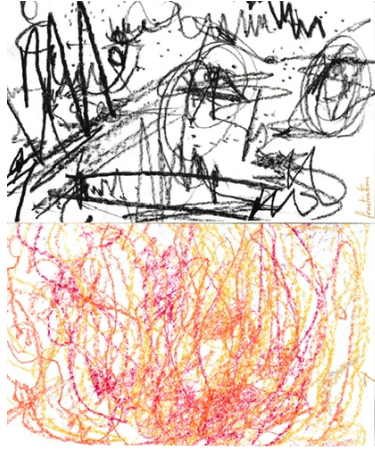

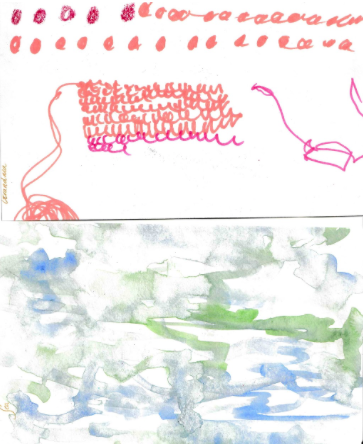

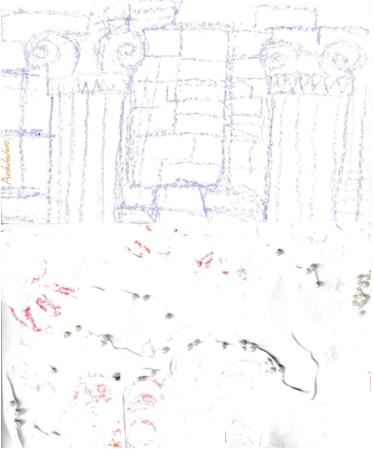

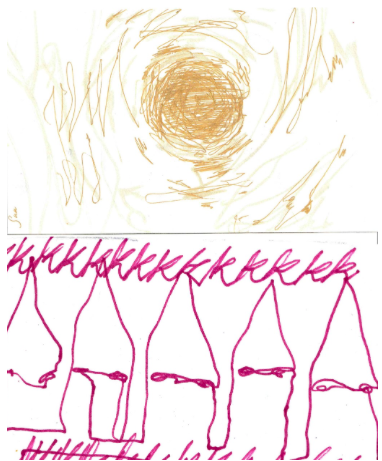
Frustration and Fire
Grandma and Water
Architecture and Tudor
Sun and Cult
The second part of our studio session involved responding to randomly selected words from our list. The words were selected by tutors depending the number. I tried to respond to the words using mark making techniques and materials that I felt conveyed the feelings, meanings or connotations attached to it as best as I could. It was fun to work in this fast paced, spontaneous way. I had to think quickly as to how I could best respond to the within the time given. I feel this activity helped me to realize that , going forward, I do not need to be so precious about the work I am producing for Act one, that it should be fast paced as expressive rather than very detailed and representational. During this activity I discovered how much I love using crayons to illustrate! They make me feel more free and create such an interesting texture.
Act 1: V&A research + Responses


I was really drawn to these wall tiles from the 1600s I loved the painting style, framing and foliage surrounding the animals.
The tiles linked to the word ‘animals’ on my list. Producing studies from the tiles allowed me to experiment with a fluid, organic illustrative style as well as practicing including an environment.


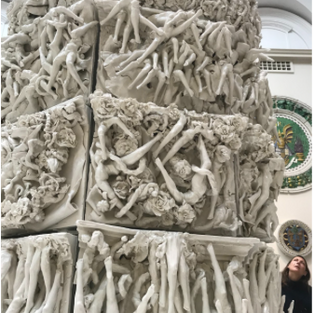

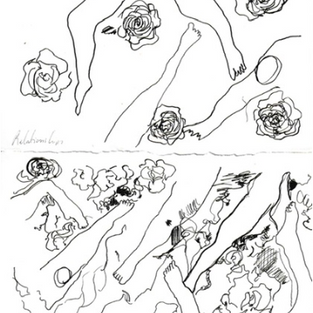
This beautiful contemporary piece by Rachel Kneebone entitled ‘399 Days’ (2014) sparked inspiration as soon as I saw it. The eruption of tangled limbs up the towering sculpture immediately made me think of the word ‘relationships’ from my list. In response created these illustrations using elegant line and a selective eye. I really love how these came out I feel that they are abstract but also representational, a strange combination that I feel is successful in conveying the original word, ‘relationships’ in mind.

An Illustration of a Bronze Venus sculpture I wanted to experiment with colour to find a way to show the word ‘love’ from my list. Vibrant colour is something quite new to me so using it for my lineart is something I found really exciting and want to experiment with more in future projects.

The picture above entitled ‘The Letter’ by Gertrude Käsebier (1906) made me think of the word ‘family’ from my list. I wanted to find a way to stylize the imagery so I could make it more my own. When I first saw the picture by the way they were positioned at first I thought they were conjoined twins. I developed from this idea and I think the outcome looks really great and I found developing illustrations from photographs a really interesting and fun process.
Act 1: Initial Idea

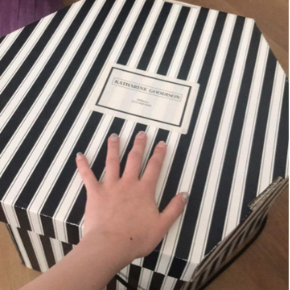

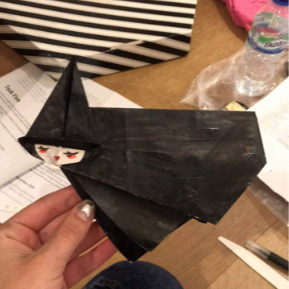
My initial idea for the box was to put a larger, smaller amount of individual pieces (such as this origami witch) into one giant hat box. I chose the hat box because I thought it was really interesting, the shape, pattern and size would help me stand out. At first I was really excited about this idea but upon putting all my work into it I felt quite underwhelmed. The work did not fill up as much of the box as I thought it would and it was really impractical to transport.
The layout of the critique
Act 1: Open Studio and Self Assessment
At the end of the two weeks we had an open studio day where we all brought our outcomes into University. I brought my large hat box outcome and immediately realised that there was still much work to be done if I wish to reach a standard I would be happy with. Assessing others work helped me to come up with great ways in which I could improve my work. Initially I thought i wanted to have a bigger box so I could ‘stand out’ but when looking around I actually realised that all the boxes that caught my eye were the smaller, more compact boxes. These, instead of having a smaller amount of large samples had a large amount of smaller samples. I realised this is where I went wrong and got to work straight after.


Act 1: Development
The first step I took in the development of my outcome was finding a smaller box, this then pathed the way for making my outcome more neat and compact.

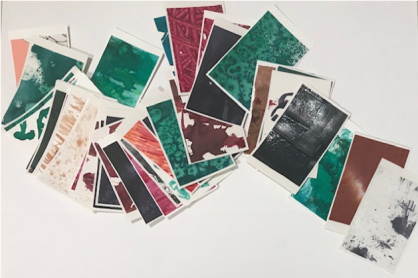
One of my tests were a series of polaroids taken inspired by the word ‘Japan’, I decided to use these as a size template when cutting down my samples so that they would as be nicely uniform and easy to flick through. I actually found the cropping process really interesting – having to really focus and chose the most interesting parts of each sample I created made me look at my work in a totally different way. I started judging by texture, uniqueness and mark making rather than just what I think looked nicest.
Although many of the boxes during the open studio inspired what is now my final outcome, one in particular left a lasting impression and I must give credit where it is due. The box done my my fellow student Katrina Anna Kravle was so beautiful and meticulous. Each of her wonderful samples were so carefully made and so interesting. It was like a little box of treasures and after seeing it I felt so motivated to make something even half as beautiful


Act 1: Final Outcome


The set outcome for Act 1 was a box or container filled with experimentational tests and illustrations inspired by words generated from an automatic writing task. At first I felt really overwhelmed by the sheer amount of work expected from us and did not feel inspired until quite a bit later into this section of the project. However, by letting go of my initial doubts and my routine processes as well as noticing where improvements must be made I was able to create work and an outcome I am excited about and will be using in future projects as a source of inspiration when stuck in creative block


Comments