

Through a Lens
- Natasha

- May 4, 2020
- 12 min read
🌳🐇
I saw this brief as an exciting opportunity to explore a process I have been interested in for ages. Something that made me nervous about this project was that we were exploring the concept of time. I knew right away that if I did not focus myself I would definitely become very overwhelmed. So in order to prevent this from happening I decided straight away that I would be looking at the idea of looping narratives as my relation to the idea of ‘time’. This idea of a narrative coming in a full circle is really interesting to me! I always get so excited when watching a movie or reading a book and you find out that in the end the whole story has started all over again! In regards to what project to develop I realised I would have to decide and stick to my decision as soon as possible. As I am not so experienced I thought that developing from a pre-created narrative (Hand and Eye) might be overwhelming as if I couldn’t create how I saw the story in my head I would be disappointed. This is why I decided to choose Hybrid forms as my starting point, as it allows for more freedom with what I create for the outcome.
Through a Lens : Starting Point


To begin developing ideas for our animation project ‘Through a Lens’ we had to choose one of the two previous projects (‘Hand and Eye’ or ‘Hybrid Forms’) or an aspect of one of those projects. Because I was interested in experimenting with stop-motion and claymation I decided to develop from the stage of my ‘Hybrid Forms’ project in which I experimented with plasticine.
Through a Lens : Artist Research


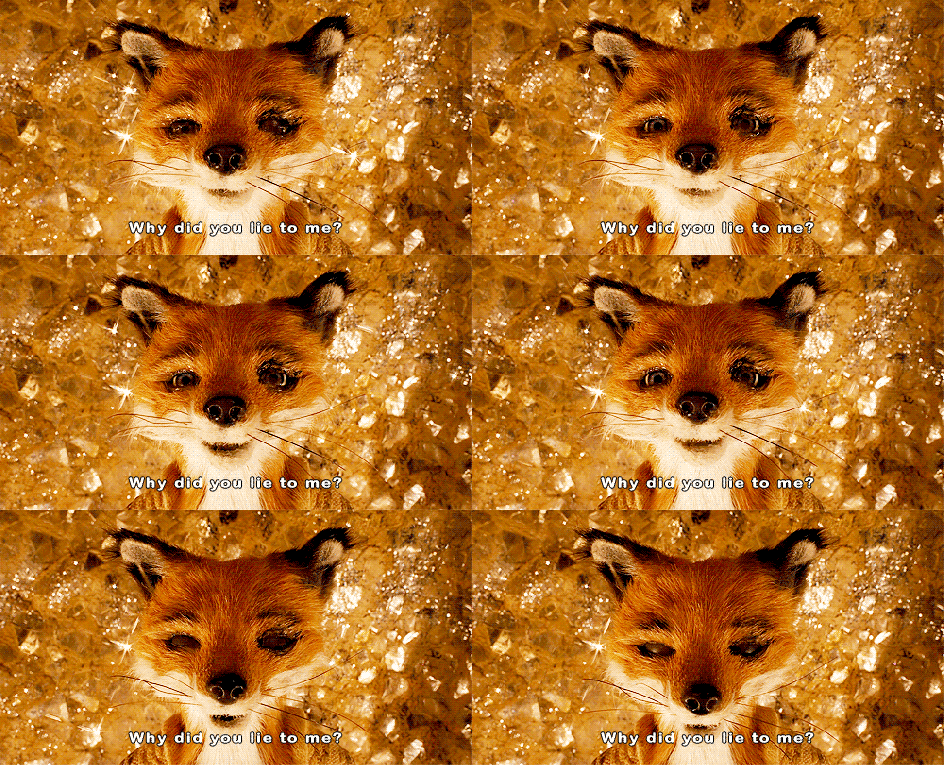


Animation has always been something I am really interested in however I have never experimented with it as I have never had the time or the software available. I am really excited for this project and to begin decided to look into two animators/animation directors that really inspire me. Firstly, Wes Anderson, what I love about the work of Wes Anderson is the beautiful and perfectly crafted colour schemes and environments.

‘[A]s a master of coordination, Wes Anderson’s sublime scenes are built from carefully curated colour palettes. The effect is to create a universe that is so perfect that the imperfections of his characters and their often dysfunctional lives and livelihoods stand out against a pristine backdrop.’ – HungerTV (2018)
I want to take inspiration from his beautifully manicured colour schemes and stills to create something that looks professional and aesthetically pleasing.
Through a Lens : Artist Research


I secondly looked at one of my personal heroes and all time greatest inspirations, Hayao Miyazaki. One of my future dreams is to work for Miyazaki in his animation studio. He values traditional animation techniques extremely and it has been an important part of the studio’s process since it was founded. This helped me to decide to for this project I will focus on traditional techniques such as stop motion and frame by frame animation to produce my outcome, as I want to start
Through a Lens : Artist Research

Looking at methods I could use to create my animation I looked into the work of Becky Solan and Joseph Pelling. Specifically this animation made for the band ‘The Dirty Paradise for their song ‘It Feels Like we Only go Backwards’. What is so amazing about this piece is that is is actually collaged and animated using stop motion. The whole thing is made up of over 1000 seperate colleges that are all individually made by hand.
If used strategically collaged animation/stop motion is an effective way of producing fluid movement in a smaller amount of time than it would take with hand drawn frame by frame techniques, so i think it would be a good route for me to chose. I have not explored animation before so I need a technique that is easy to understand and quick to use but also for as much expression as other animation techniques.
Through a Lens : Research

After the briefing, I wasn’t sure about how I should go about showing the idea of time and ‘how it flows.’ I decided to look into how others have done this. As this is an animation project I decided to look into other motion pictures.For example the movie ‘Groundhog Day’.
It explores the idea of looping narrative and how this has an effect on a character that is aware of the loop. A looping narrative could be a good way to explore the idea of flowing time and I should consider this when I am creating a storyboard ...
Through a Lens : Idea Development
To get straight into animation I created a storyboard for a short test clip. I wanted to create a little animated transformation of the character ‘兎’ into a rabbit.

For this animation I used the app ‘Stop Motion Studio’. I am happy with how this turned out as it is smooth and the colours compliment each other. However, I wish that the final image was more central as it ended up to high up in the frame. I also wish that I could have been able to fit more in the frame as the way I was filming meant that some of the image got cropped out.
Going forward I need to invest in a phone tripod to help make sure I can keep the frame steady and fit more inside it. For this animation I actually stuck my phone to a camera tripod using white tac and clay so it was slightly unsteady.
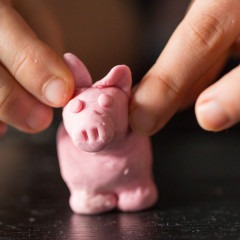


For the claymation I used Lush’s pink ‘fun’. It is better for the environment, less wasteful money goes to charity. Although I did manage to produce an animation that I am happy with I found this material very difficult to work with – it crumbled and broke quite easily which made it difficult to keep the animation neat and meant that the sculpting took a lot longer than it should have.
Through a Lens : Idea Development

Above is my second storyboard, developed from the research done into looping narratives and my own personal interests I decided to create a story exploring a parent’s love and sacrifice, how they are willing to do whatever it takes to save their children. I also wanted to introduce the idea of the contrast of imperfect lives against a ‘pristine backdrop’ seen in the work of Wes Anderson – so in the final animation I looked into using happy, exciting colours and warm lighting to create an idealistic atmosphere. The loop in this story is that the rabbit at the beginning is actually the baby at the end.
This animation turned out well. I am very happy with the amount of movement I was able to capture in a short time. For this animation I used the app ‘Stop Motion studio’ again. Instead of using clay or ‘fun’ I used individual paper cut outs of the rabbits in different positions to create movement along with the same base background from the first animation. This stop motion animation took me only 1-2 hours and is 98 frames – drawing this by hand would have taken much much longer so creating this animation helped me to confirm the technique I will be using for my final. I also feel the colours worked well in conveying what I intended – at first glance it seems a happy scenario because of the effect created by the colours but when seeing the story unfold it turns out differently.
Through a Lens : Tutorial

In my tutorial my tutor and I discussed some ideas I have already been exploring as well as how I can develop my project further. We talked about how I should look further into the idea of families. This made me think about my family and how we all have a love for rabbits – it’s something that is passed down between us. I think it would be interesting to look into this further and see how I can show this idea in a story.
This is when I thought about using the visual of a family tree. The family tree could be the base and then I animate on top of it – be it animating each member of the family or something interacting with the tree.
Through a Lens : Research

Something I was struggling with was thinking about ways I could present a family tree creatively while not making it too generic and boring. This is when I thought back to my tutorial with my tutor and remembered something mentioned – The Black family tree in Harry Potter. It is an amazing piece of design work and looks like a genuine, medieval, magical artefact. I thought that animating on top of something like this could add a sense of wonder to my work.
When deciding how I should add an animated aspect to this concept and what kind of outcome it should be I decided on AR. I thought about how family trees are usually viewed or displayed and this is not through a screen. I thought about my grandma and how she keeps my family’s family tree and adds to it by hand through research, the different handwriting on it – the handwriting of my ancestors. I decided that I want to create something handmade/ drawn that can be appreciated as an artwork in itself then create an AR animation on top of this piece, combining digital and traditional to respect the original format of family trees and reflect my experience with them.
Through a Lens : Artist Research


As for style I looked into two different sources for inspiration – the first being the drawings of Beatrix Potter for her stories about Peter Rabbit. What I love is how she is able to create a family of rabbits that all look similar as well as different and their own individuals.
The use of accessories, expressions and body language is taken into consideration. I want to combine these aspects with my own style as well as aspects from the Black family portrait to create something unique and beautiful.
Through a Lens : Research


Secondly, I looked into how rabbits are portrayed in European tapestry. I have looked into tapestry as a source of inspiration in previous projects, there is something about it that really draws me in… the pattern, the narrative, the textures… it is all so interesting for me. Considering I will be animating a part of my piece I thought that I should look into how I can make it an easier process – using a more simplistic style like this for the part I need to animate could be a good way to achieve this. I also want to take inspiration from the tapestries in regard to their texture, I feel using fabric as a base for my piece will add depth and more visual interest than if I just do it on paper.
Through a Lens: Final outcome Process

Step 1
To begin making my final outcome I first painted the fabric using white wall paint and Prussian Blue ink. I used to wall paint to try and make the fabric firmer and less droopy so when it comes to displaying it hanging it on the wall will be easier. The ink was for colour – unfortunately I was unable to get a darker colour than the one seen with the ink as it wouldn’t mix with the wall paint. However, it became darker in some spots which created an interesting aged effect at could work very well with the aesthetic I am trying to produce.

Step 2
After letting the base colour dry I added a top and bottom banner to the piece. The writing in latin is non habent caritatem cuniculosae celtiberiae which means in English I have a love for rabbits I thought this was a nice touch directly drawn from the black family tree as not only does it add to the authenticity of the overall look but it also adds a sense of humour for those who know the meaning as well as relating back to my original concept. The tree was painted using acrylic paint, drawing inspiration for the colours from Wes Anderson films: white, light pink, lime green and warm browns. I also had to use tipp-ex to fill in some part of the tree as even with multiple layers of paint the blue still shines through. Again this was somewhat of a happy accident as the tipp-ex cracks slightly and adds to that worn, old aesthetic I am trying to achieve with this outcome.

Step 3
I then began drawing the family members and their name banners onto fabric I had stuck backed with good quality sketchbook paper. Most of their designs were created from the top of my head but some (for example the one shown) were drawn from my stylistic experiments as well as family members seen on the black family tree. I wanted to go for a medieval-victorian-gothic aesthetic when it came to the clothing and names used. I also made reference to some of my inspirations using the characters in the piece, for example: ‘Beatrix’ after Beatrix Potter and ‘Fleur’ after the Millefleur style of tapestry I so love.

Step 4
Finally, I placed all of the characters as well as their name plates onto the tree, it was difficult to decide how to place them at first but I feel as if the characters I have placed together look like they could be immediate family.
Through a Lens : Final Outcome Take 1
This is the first attempt at creating the animated part of my AR. It was created using individual cutouts of each position the rabbit needs to be in. I am happy with how this animation turned out in the case of capturing the movement on it’s fluidity, however I feel the quality is poor and needs to be improved for the final thing.
The problems that occurred where that firstly, for some reason this time when using the camera through the stop motion app it caused a decrease in quality which meant the animation looks blurred and unclear. Secondly, the tripod I bought for my phone was not as stable as I needed it to be and mean I had to hold the phone whilst pressing the camera button to make sure it didn’t fall over. This resulted in my thumb being in the corner of some of the shots without me realising…
However, something I was happy with that was actually an accident was how the lighting on the piece slightly flickers, this may be from my shadow and the piece was on a wall with the lighting coming from a window behind me but I’m not sure. I like this effect as it gives it the vintage/old-style feel I was looking to achieve in this piece. However, as I am planning to redo this animation I am not sure if I will be able to achieve the same effect on purpose.
Going forward, I will now redo my animation using higher quality images taken on a digital camera with a sturdy tripod. There is a feature on the stop motion app that allows you to import photos onto the app from your gallery so this could be a way around the low-quality images I got when using my phone camera through the app.
Through a Lens : Final Outcome
My second and final attempt at the animation turned out well. This colour is more vibrant, the background is more stable and the quality is a little better. However, it is still not perfect. I feel the fluidity on the animation is more ‘jumpy’ that my first attempt, this is because at the end I made some. mistakes with the frames and has to sacrifice about four frame to fix that mistake. I also feel that the quality is still not as good as I would like it to be and wonder if using the ‘Stop Motion studio’ app is the reason for the decrease in quality as when I took the pictures using the higher quality camera they were not blurry at all. However, with this slight increase in quality I wonder if it has lost some of the charm the first piece had? My first attempt was less vibrant but this in turn also added to the ‘vintage’ aesthetic I was aiming for and the shadows over the pice gave it a similar effect to that of an old movie. With this in mind I feel that my ideal outcome would have been a combination of my two attempts, the fluidity of movement, colour and lighting of the first piece with the increased sharpness and better framing (no fingers or jumpy backgrounds) of this piece.
Through a Lens : Evaluation
All things considered, I am happy with how my animation turned out. I am proud of what I have managed to achieve in my first attempt at animation, even if I still have a lot to learn. The movement captured is fluid and the narrative behind the piece is presented well. I am also satisfied with the quality of the illustration, I think that the family tree itself is a beautiful outcome in its own right.
If I were to develop this project further I would love to look more into a character-based narrative. Character creation is one of my passions and although my outcome does feature characters it does not explore them in any depth as individuals. However, building a character and telling their story in detail takes a very long time and this kind of project would not have been suitable for the timescale given to us.
As for what I can improve, I think that next time I animate I should invest in better software. Although the app ‘Stop Motion Studio’ does the job well of putting together an animation quickly, I noticed that it greatly reduces the quality of the images I put through the app. I would also like to look into digital drawing softwares such as photoshop or procreate. Still using traditional animation methods, I would like to see how my work could be elevated by exploring this media.
To conclude, throughout the development of this project I have learned a lot about my practice, my interests and about a field I could be progressing into. I am very happy with what I am managed to produce, and have been able to create pieces that I am very proud of. Be it because of how they look, move or both combined. However, I still have much to learn when it comes to this process. I need to make sure that in the future I take the time to learn more complex software so I can present my work to the highest quality I am able to. I also should consider exploring animation in a long-term project. A project in which I can look into character and narrative in more detail.


Comments